

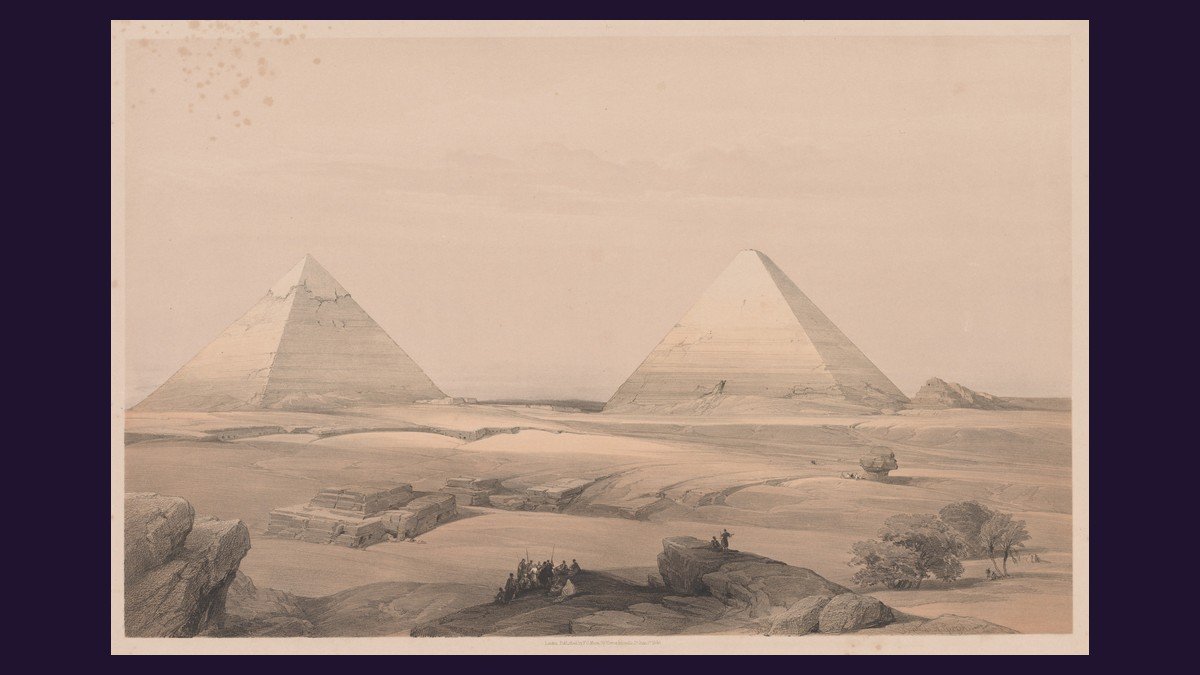
Pillars Beneath Khafre? Where the Giza Radar Claim Stands in 2026
Few places pull at the imagination like the Giza Plateau. So when a team of researchers announced in March 2025 that satellite radar had revealed colossal structures hidden deep beneath the Pyramid of Khafre, the story spread across the internet within days. Nineteen months later, it is worth taking a calm look at what was actually claimed, how experts responded, and what has changed since.
The claim
The announcement came from three Italian researchers: Corrado Malanga, associated with the University of Pisa; Filippo Biondi, a radar specialist associated with the University of Strathclyde; and Armando Mei, a researcher of ancient Egypt. At a press conference in Italy in mid-March 2025 (reports date it between 15 and 23 March), they presented images and reconstructions they said came from a new way of interpreting satellite radar data.
According to their press material, as summarised by Ahram Online, National Geographic and others, they described:
- Five multi-level structures inside the pyramid, connected by pathways.
- Eight hollow, cylindrical vertical shafts, or “wells,” arranged in two parallel rows, each wrapped by a spiral pathway, descending about 648 metres (roughly 2,130 feet) below the pyramid.
- Two large cube-shaped structures, reported at around 80 to 90 metres per side, where the shafts meet.
- Further features reaching as deep as about two kilometres beneath the plateau.
Some coverage, and many enthusiasts online, linked the findings to the legendary Hall of Records or to ideas of an ancient power plant. Those interpretations went well beyond the data the team itself showed.
The method
The technique is based on Synthetic Aperture Radar, or SAR, the satellite imaging used to map the Earth’s surface. Ordinary SAR does not see through solid rock to any great depth. The team’s approach is different in principle: Biondi has explained that the method reads tiny vibrations of the ground and the monument from the radar’s Doppler signal, treats them almost like sound, and inverts them into a three-dimensional picture. In other words, they argue they are reading surface vibrations that carry information about what lies below, not shining radar straight down into the bedrock.
The work built on a 2022 paper by Biondi and Malanga in the journal Remote Sensing, which applied the same Doppler tomography idea to the Great Pyramid of Khufu (not Khafre) and reported previously unrecorded rooms and corridors. The Khafre results themselves were never published in a peer-reviewed journal.
The response from experts
The reaction from specialists was swift. Zahi Hawass, the former Egyptian Minister of Antiquities, called the information “completely wrong” with “no scientific basis,” and said in a 26 March 2025 statement that Egypt’s Ministry of Tourism and Antiquities had not authorised any work inside or around the Khafre pyramid.
Lawrence Conyers of the University of Denver, a specialist in ground-penetrating radar, described the underground-city idea as “a huge exaggeration,” saying radar waves gradually weaken in the ground and cannot reach such depths. Interestingly, he also noted that smaller natural or ancient features, such as shafts or caves, could plausibly exist beneath the pyramids, pointing out that peoples in Mesoamerica often built pyramids over caves of ceremonial importance. Egyptologist Jean-Guillaume Olette-Pelletier told AFP there is no evidence of underground networks at the depths described, and National Geographic highlighted the gap between the raw radar images and the elaborate reconstructions.
What has changed since
The biggest development came on 10 August 2026, when Remote Sensing retracted the 2022 Great Pyramid paper. The journal said an investigation, prompted by a reader’s concerns, “confirmed serious methodological flaws and statistical errors” that undermined its conclusions. The authors were informed and said they disagreed with the decision. Reporting on the retraction noted it did not allege fabrication or misconduct.
Independent testing has also appeared. A preprint posted on Zenodo, with open code and revised through August 2026, attempted to rebuild the Doppler method from the authors’ papers and patent and test it against control data. Its author reported no reproducible deep structures, only surface-related artefacts. It is not peer-reviewed either, and its author has openly withdrawn some earlier claims in later versions, a reminder that this debate is still being worked out in public.
Meanwhile, the story has kept travelling through podcasts and television documentaries. But as of early November 2026, I could find no report of any excavation, drilling, permitted field survey or independent scan confirming the shafts, and no Egyptian ministry announcement of new work on the claim.
Confirmed versus claimed
Confirmed: a team announced the findings in March 2025; Egyptian authorities say they did not permit work at Khafre; the Khafre results were never peer-reviewed; and the related 2022 paper was retracted in August 2026.
Claimed, not verified: eight shafts around 648 metres deep, spiral pathways, giant cubic chambers and structures down to two kilometres.
None of this means the Giza Plateau has given up all its secrets. Scanning projects such as ScanPyramids have found genuine voids inside the Great Pyramid using well-tested methods. The ground beneath Khafre may hold surprises of its own one day. For now, though, the eight pillars remain an idea waiting for evidence, and that is the most honest place to leave them.