
Most of us have a book we were told to love and never could. For Thomas Jefferson, that book was Plato’s Republic. He read it carefully, in his seventies, and came away annoyed. His letters about it are some of the funniest and sharpest things he ever wrote, and they tell us a lot about the kind of thinking he did value.
Let’s start with the complaint, then meet the people Jefferson actually looked up to.
A Summer Spent “Wading” Through the Republic
On July 5, 1814, Jefferson wrote to his old friend and rival John Adams. He had just spent five weeks at what he called “my other home,” where he had more time to read. He did not enjoy it:
“I amused myself with reading seriously Plato’s republic. I am wrong however in calling it amusement, for it was the heaviest task-work I ever went through.”
He went on, and he did not soften the blow:
“while wading thro’ the whimsies, the puerilities, & unintelligible jargon of this work, I laid it down often to ask myself how it could have been that the world should have so long consented to give reputation to such nonsense as this?”
Jefferson believed Plato’s fame rested on fashion and authority rather than sound reasoning. Strip away the style, he said, and “take from him his sophisms, futilities, & incomprehensibilities, and what remains?” His answer was blunt: Plato was “one of the race of genuine Sophists,” and “his foggy mind, is for ever presenting the semblances of objects which, half seen thro’ a mist, can be defined neither in form or dimension.”
He also defended Socrates against his most famous student: “Socrates had reason indeed to complain of the misrepresentations of Plato; for in truth his dialogues are libels on Socrates.”
Plato and “Artificial Christianity”
A big part of Jefferson’s irritation was religious. He believed later church thinkers had borrowed Plato’s mysticism to complicate a simple moral message. In the same letter he wrote:
“The doctrines which flowed from the lips of Jesus himself are within the comprehension of a child; but thousands of volumes have not yet explained the Platonisms engrafted on them: and for this obvious reason that nonsense can never be explained.”
He was just as unimpressed with Plato’s politics. It was lucky, he joked, that “Platonic republicanism has not obtained the same favor as Platonic Christianity; or we should now have been all living, men, women and children, pell mell together, like the beasts of the field or forest.”
Five years later he hadn’t changed his mind. Writing to William Short on October 31, 1819, he called Plato a man “dealing out mysticisms incomprehensible to the human mind,” whose “foggy conceptions” offered “a basis of impenetrable darkness.” He added that “of Socrates we have nothing genuine but in the Memorabilia of Xenophon.”
So much for Plato. Who earned Jefferson’s respect?
The Trinity: Bacon, Newton and Locke
In 1789, while serving as minister to France, Jefferson asked the painter John Trumbull to have portraits copied of Francis Bacon, Isaac Newton and John Locke. He explained that he considered them “as the three greatest men that have ever lived, without any exception, and as having laid the foundations of those superstructures which have been raised in the Physical & Moral sciences.”
Years later, in a January 16, 1811 letter to Benjamin Rush, he recalled a dinner at which Alexander Hamilton noticed portraits of Bacon, Newton and Locke hanging in the room and asked who they were. “I told him they were my trinity of the three greatest men the world had ever produced, naming them. he paused for some time: ‘the greatest man, said he, that ever lived was Julius Caesar.’” You can learn a lot about two people from that exchange.
What links the three is method: Bacon’s experiment and observation, Newton’s mathematical laws, Locke’s account of knowledge and government grounded in experience and consent. These were thinkers you could test. That was exactly what Jefferson found missing in Plato.
“I Too Am an Epicurean”
The same 1819 letter to William Short holds Jefferson’s warmest philosophical confession:
“As you say of yourself, I too am an Epicurean. I consider the genuine (not the imputed) doctrines of Epicurus as containing every thing rational in moral philosophy which Greece & Rome have left us.”
Note the phrase “not the imputed.” Jefferson knew Epicurus had a reputation for mere pleasure-seeking, and he rejected it. He even scolded Short for being lazy, reminding him that “fortitude, you know, is one of his four cardinal virtues.” For Jefferson, Epicurean happiness meant a well-ordered life, not a lazy one.
Epictetus, Seneca and Cicero
Jefferson’s view of the Stoics was mixed but generous. “Epictetus indeed has given us what was good of the Stoics,” he told Short, and “Seneca is indeed a fine moralist, disfiguring his work at times with some Stoicisms, and affecting too much of antithesis and point, yet giving us on the whole a great deal of sound and practical morality.”
Cicero got a more complicated review. In the 1819 letter, Jefferson found Cicero’s philosophy “diffuse, vapid, rhetorical, but enchanting.” Yet in the 1814 letter to Adams he called Cicero “able, learned, laborious, practised in the business of the world, & honest,” and the “first master in the world” of style. He admired the man more than the metaphysics.
Jesus as a Moral Teacher
For Jefferson, the greatest moral teacher of all was Jesus, understood as a reformer rather than a figure of doctrine. He told Short that once Jesus’s own words were separated from later additions, “we have the outlines of a system of the most sublime morality which has ever fallen from the lips of man.” He summed up the division of labor neatly: “Epictetus & Epicurus give us laws for governing ourselves, Jesus a supplement of the duties & charities we owe to others.”
He acted on this. Around 1820 he took a razor to copies of the New Testament in Greek, Latin, French and English and pasted the moral teachings into a volume he titled The Life and Morals of Jesus of Nazareth, now known as the Jefferson Bible and preserved by the Smithsonian. Miracles and other supernatural passages were left out.
Tacitus, “the First Writer in the World”
Finally, history. On December 8, 1808, Jefferson wrote to his granddaughter Anne Cary Randolph Bankhead, praising her winter reading list:
“Tacitus I consider as the first writer in the world without a single exception. his book is a compound of history & morality of which we have no other example.”
That phrase, “history & morality,” captures what Jefferson wanted from every author: clear facts joined to practical lessons about how to live.
What It All Adds Up To
Put the pieces together and a pattern appears. Jefferson trusted thinkers who were clear, practical and testable: the scientist, the empiricist, the moralist of daily conduct, the honest historian. He distrusted grand systems that, in his words, could be “defined neither in form or dimension.” You don’t have to agree with him about Plato to appreciate the standard he set: if an idea can’t be stated plainly, it may not yet be understood.
If these old arguments are your kind of conversation, our philosophy tees are a quiet way to carry one with you: the Jefferson vs. Plato “Libels on Socrates” Tee, the Plato & Jefferson Philosophy Tee, the Plato & Jefferson Know Thyself Tee, the Jefferson Portrait Sunburst Tee, the Jefferson Monticello Moon Tee, the Virginia Monticello Jefferson Tee, and the Plato Nature Is As Nature Does Tee.
—
Sources
– Thomas Jefferson to John Adams, 5 July 1814, Founders Online: https://founders.archives.gov/documents/Jefferson/03-07-02-0341 – Thomas Jefferson to William Short, 31 October 1819, Founders Online: https://founders.archives.gov/documents/Jefferson/03-15-02-0141-0001 – Thomas Jefferson to John Trumbull, 15 February 1789, Library of Congress exhibition: https://www.loc.gov/exhibits/jefferson/18.html – Extract from Thomas Jefferson to Benjamin Rush, 16 January 1811, Monticello, Jefferson Quotes & Family Letters: https://tjrs.monticello.org/tjrs-categorizations/influences?page=1 – From Thomas Jefferson to Anne Cary Randolph Bankhead, 8 December 1808, Founders Online (Early Access): https://founders.archives.gov/documents/Jefferson/99-01-02-9252 – The Jefferson Bible, National Museum of American History, Smithsonian: https://www.americanhistory.si.edu/JeffersonBible/history/ – Smithsonian collection record, The Life and Morals of Jesus of Nazareth: https://www.si.edu/object/thomas-jefferson-life-and-morals-jesus-nazareth-extracted-textually-gospels-greek-latin-french%3Anmah_213626
Cover Image Credit
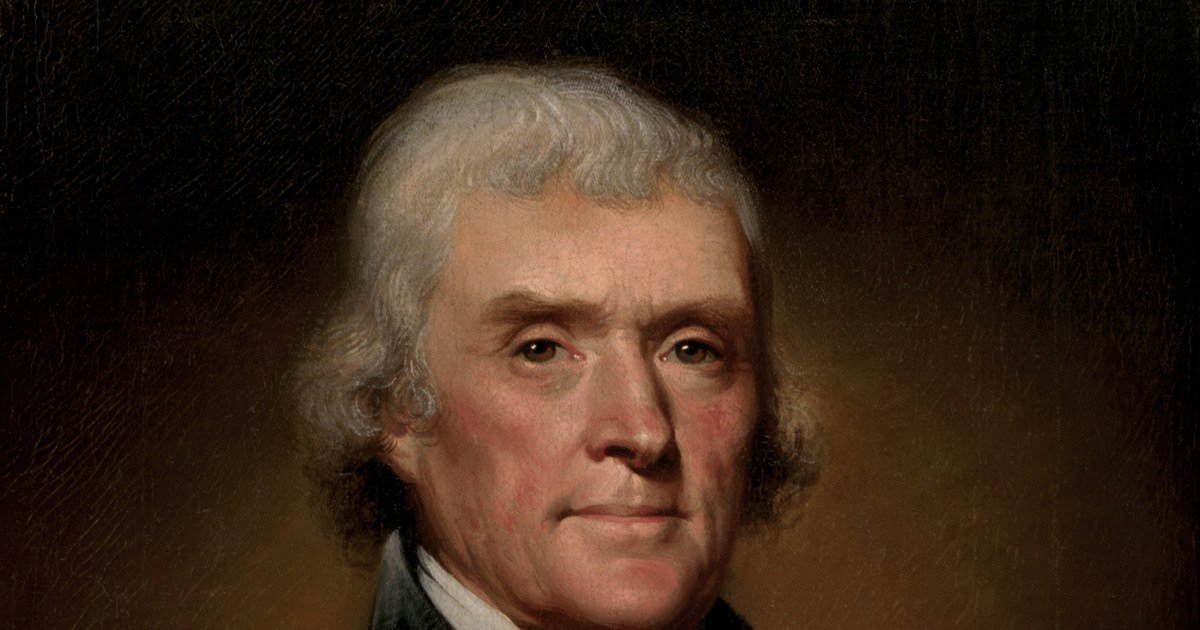
Thomas Jefferson, by Rembrandt Peale, oil on canvas, 1800 (White House collection). Public domain. Source: Wikimedia Commons, https://commons.wikimedia.org/wiki/File:Official_Presidential_portrait_of_Thomas_Jefferson_(by_Rembrandt_Peale,_1800).jpg
Sources
- Thomas Jefferson to John Adams, 5 July 1814, Founders Online
- Thomas Jefferson to William Short, 31 October 1819, Founders Online
- Thomas Jefferson to John Trumbull, 15 February 1789, Library of Congress
- Thomas Jefferson to Benjamin Rush, 16 January 1811, Founders Online
- Thomas Jefferson to Anne Cary Randolph Bankhead, 8 December 1808, Founders Online
- The Jefferson Bible, National Museum of American History, Smithsonian
- The Life and Morals of Jesus of Nazareth, Smithsonian collection record