
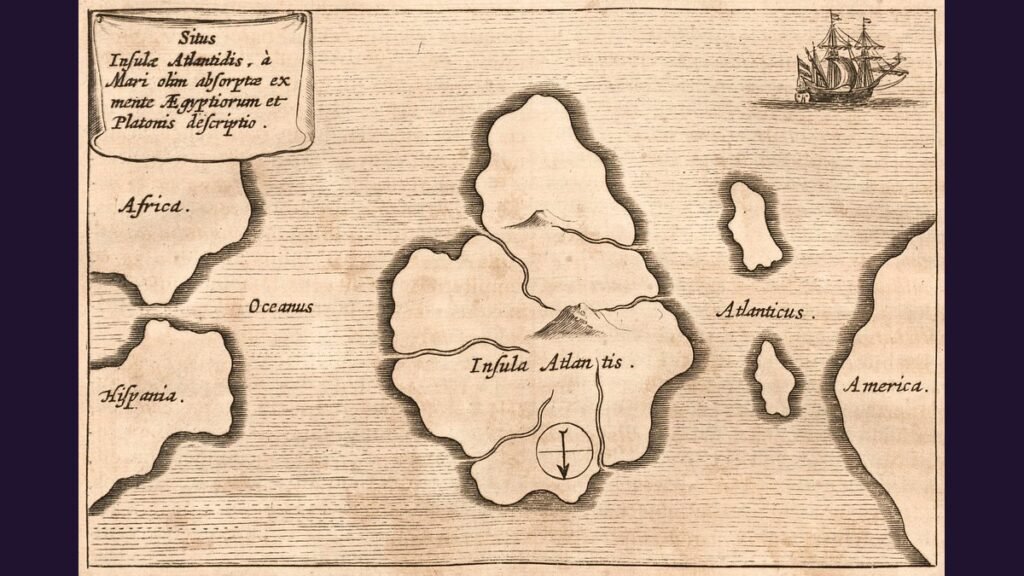
Few stories have traveled as far as Atlantis. A single account, written by a Greek philosopher around 2,400 years ago, has inspired explorers, novelists, artists and a whole shelf of modern theories. Before looking at where some modern researchers place the lost island, it helps to go back to the source and see what Plato actually wrote.
Plato’s Account: Timaeus and Critias
Atlantis appears in two of Plato’s late dialogues, the Timaeus and the unfinished Critias. The story is told by Critias, who says it came down through his family from Solon, the Athenian lawgiver. Solon, in turn, heard it from Egyptian priests at Sais, a city in the Nile Delta, who claimed their temple records reached far deeper into the past than anything the Greeks remembered.
According to the priests, the events took place about 9,000 years before Solon’s time. Since Solon lived around 600 BC, that places Atlantis roughly 9600 BC, a date that matters a great deal to the modern theorists below.
The location is given as an island in the Atlantic, “beyond” the Pillars of Heracles, the old name for the Strait of Gibraltar. In the Jowett translation, the priest tells Solon:
“there was an island situated in front of the straits which are by you called the Pillars of Heracles; the island was larger than Libya and Asia put together”
(Plato, Timaeus 24e, trans. Benjamin Jowett)
In the Critias, Plato describes how the island came to be. The sea god Poseidon fell in love with a mortal woman named Cleito and fortified the hill where she lived, “making alternate zones of sea and land larger and smaller, encircling one another; there were two of land and three of water” (Critias 113d). Those concentric rings became the heart of a capital city, ruled by ten kings descended from Poseidon. The island grew rich, with harbors, canals, temples and a powerful navy.
Over time, the story goes, the kings grew proud and greedy. Atlantis launched a war to conquer the lands inside the Mediterranean, pushing as far as Egypt and Tyrrhenia (central Italy). Ancient Athens led the resistance, and after standing alone, defeated the invaders. Then disaster struck both sides:
“there occurred violent earthquakes and floods; and in a single day and night of misfortune all your warlike men in a body sank into the earth, and the island of Atlantis in like manner disappeared in the depths of the sea.”
(Plato, Timaeus 25c-d, trans. Benjamin Jowett)
Most classical scholars read Atlantis as a philosophical parable, a story about pride, power and an idealized early Athens, rather than a historical record. Still, the details Plato chose, especially the 9,000-year date and the sudden flood, have proved irresistible to people looking for real events behind the myth.
Graham Hancock: A Lost Ice Age Civilization
British author Graham Hancock has spent decades arguing that an advanced civilization existed during the last Ice Age and was wiped out by a global catastrophe. Its survivors, he suggests, passed knowledge to later cultures.
In Fingerprints of the Gods (1995), Hancock presented the idea, developed by Canadian authors Rand and Rose Flem-Ath in When the Sky Fell, that Antarctica was once positioned some 2,000 miles farther north and could have been home to Atlantis before a shift of the Earth’s crust moved it under the ice. Hancock has stressed that the Antarctica theory belongs to the Flem-Aths and that he reported and synthesized it.
In Magicians of the Gods (2015), his focus moved to the Younger Dryas impact hypothesis: the idea that fragments of a comet struck the Earth around 12,800 years ago, triggering a sudden cold snap, followed by melting ice, floods and rising seas. He connects this to sites such as Göbekli Tepe in Turkey and the Great Sphinx at Giza. America Before (2019) extends the search to North and South America.
Randall Carlson: Cataclysm, Floods and Geometry
Randall Carlson, a researcher and longtime collaborator of Hancock’s, approaches the same period through geology. He has studied the Channeled Scablands of eastern Washington State for years, pointing to giant current ripples, scoured canyons and boulders carried far from home as evidence of enormous Ice Age floods from glacial Lake Missoula. Carlson argues these megafloods, and the sudden climate swings of the Younger Dryas, may have been driven by cosmic impacts.
On Atlantis, Carlson draws attention to Plato’s timing. The end of the Younger Dryas, about 11,600 years ago, lines up closely with Plato’s date of roughly 9600 BC, a time of rapid warming and sharp sea-level rise. Carlson is also known for his work on sacred geometry, studying the proportions and patterns found in ancient architecture and nature.
A Fair Word on the Debate
Both men present their work as open questions, and both have drawn large audiences. It is worth being clear, though: these are alternative theories, not accepted by mainstream archaeology or geology. The Younger Dryas impact hypothesis remains contested, and a 2023 review in Earth-Science Reviews argued it should be rejected. Crust displacement is not supported by current geology, and no archaeological remains of an Ice Age advanced civilization have been found.
Even so, the conversation keeps Plato’s story alive. Whether Atlantis was a moral fable, a distorted memory of real floods, or something else, it remains one of the great images in human imagination: a ringed city of sea and land, lost beneath the waves in a single day and night.
Sources: Plato, Timaeus and Critias, trans. Benjamin Jowett (Project Gutenberg); Graham Hancock, Fingerprints of the Gods, Magicians of the Gods, America Before; Randall Carlson interviews.