
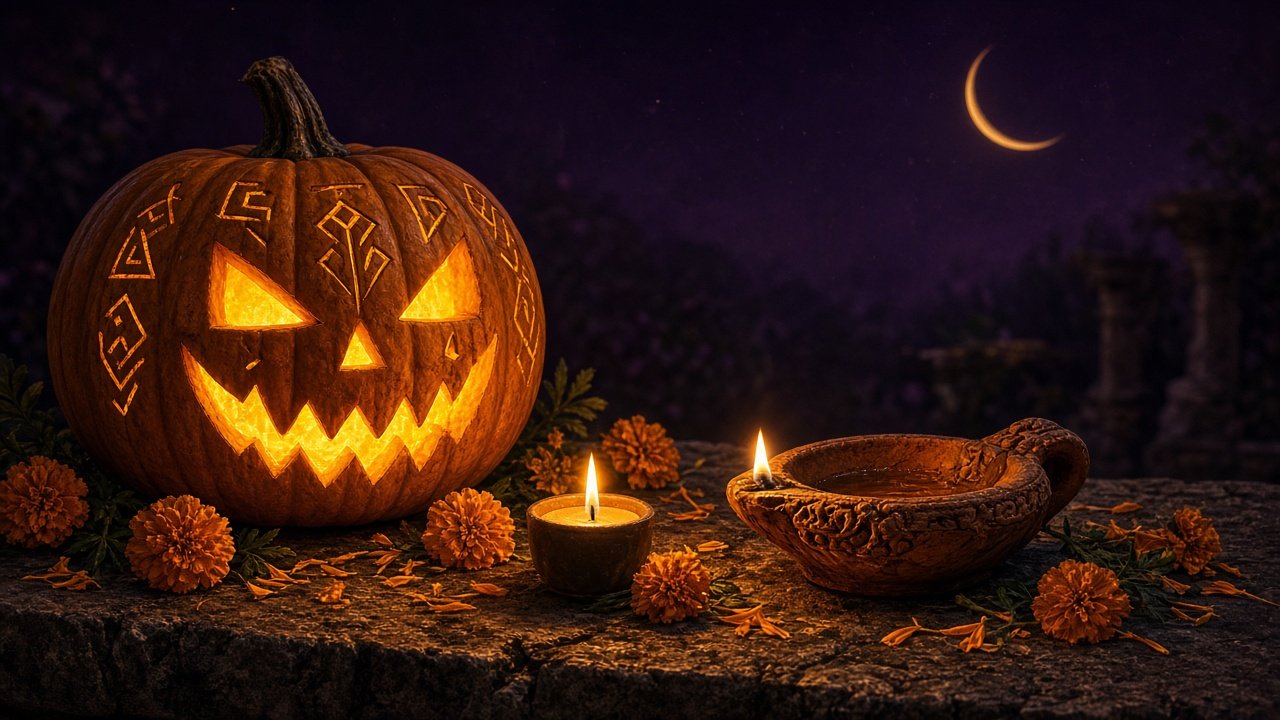
Tomorrow is Halloween. Porch lights will glow, costumes will come out, and somewhere a carved pumpkin will grin at the dark. Most of us keep holidays out of habit, yet nearly every one of them began as an answer to something very old: the shortening of the days, the loss of the people we love, the relief of a harvest brought in. Let’s walk the calendar back to its ancient roots, separate the history from the internet myths, and listen to what the philosophers had to say about the same seasons.
“To every thing there is a season, and a time to every purpose under the heaven.” (Ecclesiastes 3:1, King James Version)
Halloween: Samhain and the Turning of the Year
Long before trick-or-treating, the Gaelic peoples of Ireland and Scotland marked Samhain around the first of November. It closed the harvest and opened the dark half of the year. Medieval Irish tales describe it as a time when the boundary with the Otherworld grew thin and spirits could cross over. Those tales were written down by Christian monks centuries later, so historians are careful about how much they tell us about pre-Christian practice, and some scholars, such as Ronald Hutton, caution against drawing a straight line from Samhain to modern Halloween.
The Christian thread is clearer. Pope Gregory III (731 to 741) dedicated an oratory in St. Peter’s to all the saints (later tradition places the dedication on November 1, though some historians date it to April 732), and under Pope Gregory IV in the 830s the feast of All Saints on that date spread across the Frankish lands. The night before became All Hallows’ Eve, which in time shortened to “Halloween.” Whether the church chose November 1 to absorb Samhain is still debated; the two traditions certainly blended in Ireland and Scotland.
Either way, the instinct is the same: as the light fails, gather close and remember. Plato had Socrates put it plainly on the day of his death:
“For is not philosophy the practice of death?” (Plato, Phaedo, tr. Benjamin Jowett)
He did not mean gloom. He meant that facing mortality honestly frees us to live well.
Day of the Dead: Remembering With Joy
In Mexico, Día de los Muertos (November 1 and 2) welcomes the dead home with ofrendas, marigolds, sugar skulls and favorite foods. Its roots are often traced to Aztec festivals honoring Mictecacihuatl, the Lady of the Dead, celebrated in the summer months of the Aztec calendar. After the Spanish conquest, those customs merged with the Catholic days of All Saints and All Souls. Scholars still argue over how much is indigenous and how much is colonial Catholic; the honest answer is that it is both. UNESCO recognized the tradition as part of humanity’s intangible cultural heritage in 2008.
Epictetus offered a Stoic way to hold such grief:
“Never say of anything, ‘I have lost it,’ but, ‘I have restored it.’ Has your child died? It is restored.” (Epictetus, Enchiridion XI, tr. Thomas W. Higginson)
It sounds stern at first. Read again and it becomes a kind of gratitude: what we loved was a gift, and it was ours for a time.
Christmas and the Winter Solstice: Saturnalia, Sol Invictus, and Yule
The darkest days of the year have always drawn festivals. Romans kept Saturnalia from December 17, eventually stretching over several days, with feasting, gift-giving, candles, and a playful reversal in which servants and masters traded places. In 274 AD the emperor Aurelian elevated the cult of Sol Invictus, the Unconquered Sun. Farther north, Germanic peoples kept Yule at midwinter, a festival the English monk Bede mentions in the eighth century.
So was December 25 borrowed from the sun? Here it pays to be balanced. The Chronograph of 354 lists December 25 both as the birthday of the Unconquered Sun and, separately, as the birth of Christ, the earliest surviving record of either as an annual feast on that date (the writer Hippolytus had mentioned December 25 as Christ’s birth date over a century earlier, though that passage is debated). One school of thought holds that Christians chose the date to reframe the solstice feast. Another argues the date came from an early Christian calculation that placed Jesus’s conception on March 25, nine months earlier. Both views have serious scholars behind them, and the evidence does not settle it. What is not in doubt is that many familiar customs, from evergreens to candlelight to gift-giving, echo the older midwinter feasts.
The lesson of the solstice is that the night reaches its limit and turns. Heraclitus saw change as the deepest law of things, and Marcus Aurelius echoed him:
“Time is like a river made up of the events which happen, and a violent stream; for as soon as a thing has been seen, it is carried away, and another comes in its place, and this will be carried away too.” (Marcus Aurelius, Meditations IV.43, tr. George Long)
New Year: Akitu and the Two Faces of Janus
One of the oldest recorded New Year festivals is the Mesopotamian Akitu, celebrated in Babylon in the spring month of Nisannu. Over about twelve days, the god Marduk was honored, the creation epic was recited, and in one striking rite the high priest struck the king on the cheek, and tears were taken as a good omen. Even the powerful were asked to begin the year humbled.
Our January 1 comes from Rome. Roman consuls began taking office on January 1 from 153 BC, and Julius Caesar’s calendar reform, enacted in 46 BC and in force from January 1, 45 BC, fixed the date. The month itself is traditionally linked to Janus, god of doors and beginnings, shown with two faces, one looking back and one looking forward. It may be the best picture of a New Year resolution ever made: honest about the past, hopeful about what comes next.
Easter and Spring: Passover, Pascha, and the Eostre Question
Easter grew directly from Passover. The Gospels place the death and resurrection of Jesus at Passover time, and in Greek, Latin and most European languages the feast is still called Pascha, from the Hebrew Pesach.
The English name is a different story. Around 725 AD, Bede wrote that the month Eosturmonath was named for a goddess, Eostre, once honored in spring. Bede is our only ancient source for her, and scholars disagree about whether she was a real goddess of the Anglo-Saxons or a learned guess about an old month name. Popular claims that rabbits and eggs were her sacred symbols, or that “Easter” comes from Ishtar, are modern inventions without ancient support.
What spring festivals share, whatever their names, is renewal: the stone rolled away, the seed breaking the soil, the year starting over.
Valentine’s Day: The Lupercalia Link, Honestly
You will often read that Valentine’s Day replaced the Roman Lupercalia, a rough February purification festival. That link is disputed. The connection was suggested by later writers rather than shown by ancient records, and many historians doubt it. The early saints named Valentine were martyrs with no known romantic tradition. The pairing of Saint Valentine with love first shows up in surviving sources in the fourteenth century, in Geoffrey Chaucer’s Parlement of Foules, where birds choose their mates on “seynt Valentynes day.” Sometimes the truest origin story is a poet’s.
Thanksgiving and the Harvest: Sukkot, Thesmophoria, and Gratitude
Giving thanks for the harvest is one of humanity’s oldest habits. The Hebrew Bible commands Sukkot, the Feast of Tabernacles, an autumn festival of dwelling in temporary booths after the harvest is gathered (Leviticus 23). In ancient Greece, women kept the Thesmophoria for Demeter, goddess of grain, around the autumn sowing. Romans honored Ceres, and harvest-home suppers were kept across England for centuries. The American Thanksgiving remembers the 1621 harvest meal at Plymouth, and Abraham Lincoln proclaimed a national day of thanks in 1863.
Marcus Aurelius turned the harvest into a whole attitude toward life:
“Everything is fruit to me which thy seasons bring, O Nature: from thee are all things, in thee are all things, to thee all things return.” (Marcus Aurelius, Meditations IV.23, tr. George Long)
What the Old Festivals Still Teach
Put the calendar together and a pattern appears. Our holidays cluster at the hinges of the year: the harvest, the falling dark, the longest night, the return of spring. Each one asks a question the ancients took seriously. How do we hold on to the people we have lost? How do we keep faith that the light will come back? How do we give thanks without clinging? Epictetus answered with a quiet discipline:
“If you embrace your child or your wife, that you embrace a mortal—and thus, if either of them dies, you can bear it.” (Epictetus, Enchiridion III, tr. Thomas W. Higginson)
That is not coldness. It is love that knows its own season.
Closing: Marking Time on the Skin and in the Heart
Holidays are how a culture marks time together. Art is how a person does it alone: a portrait of someone gone, a symbol for a year that changed everything, an image that holds a memory still. That is what we mean by inner vision, seeing what matters and giving it a lasting form. However you spend this Halloween, light a candle for someone you remember, and keep the old wisdom close. The dark half of the year has always been followed by the light.
Sources
- Ecclesiastes, King James Version (Project Gutenberg)
- Plato, Phaedo, tr. Benjamin Jowett (Project Gutenberg)
- Epictetus, The Enchiridion, tr. Thomas W. Higginson (Project Gutenberg)
- Marcus Aurelius, Meditations, tr. George Long (Project Gutenberg)
- Samhain, Wikipedia
- All Saints' Day, Wikipedia
- Day of the Dead, Wikipedia
- Indigenous festivity dedicated to the dead, UNESCO
- Saturnalia, Wikipedia
- Sol Invictus, Wikipedia
- Christmas, Wikipedia
- Akitu, Wikipedia
- Janus, Wikipedia
- Eostre, Wikipedia
- Valentine's Day, Wikipedia
- Sukkot, Wikipedia
- Thesmophoria, Wikipedia