
When I walk among trees, I feel I am looking at the smallest part of the life around me. Trunks stand apart. Leaves move in their own air. Under the soil, though, the forest is busy in a way I cannot see.
This feeling is older than our instruments. In the late first century before the common era, painters filled an underground room at the Villa of Livia, north of Rome, with a continuous garden. Trees, birds, flowers, and a soft sky wrap the walls, so that a person standing inside seems to stand in a grove. Greeks and Romans also set real groves apart as sacred places, the alsos and the lucus, where trees belonged to a shared life. They did not know the fungi we can name today. They did know that a living place is more than a row of separate trunks.
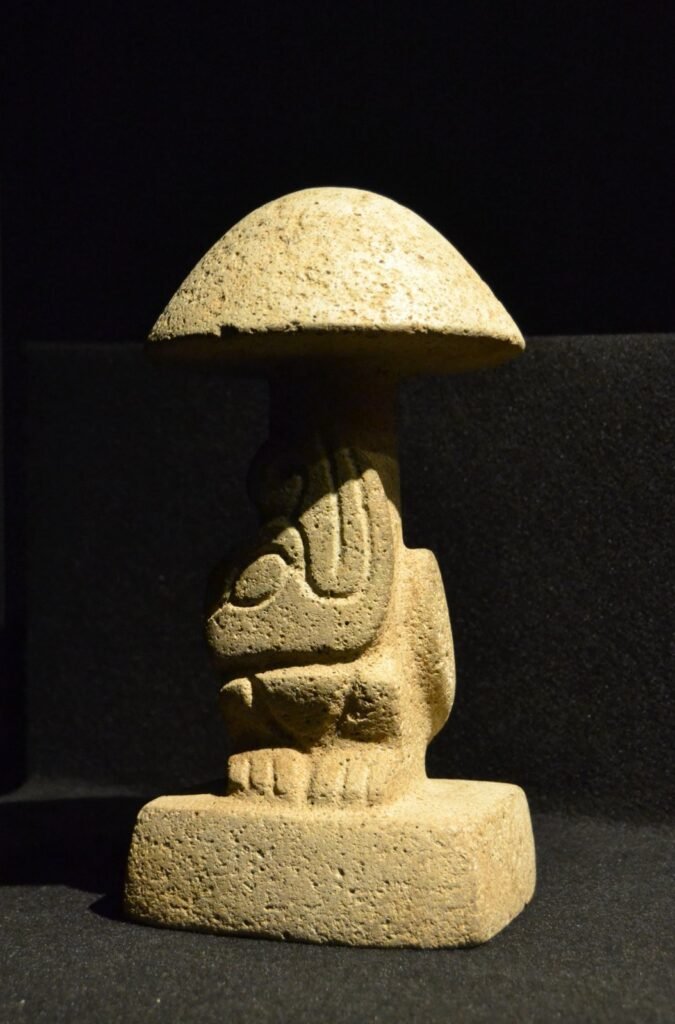
Other ancient peoples noticed fungi themselves. The basalt sculpture at the top of this page, from ancient Kaminaljuyú in highland Guatemala, takes the familiar cap-and-stem shape of a mushroom, though scholars still discuss the role these so-called mushroom stones played.
Heraclitus of Ephesus put the thought in a hard, bright line:
“It is wise to hearken, not to me, but to my Word, and to confess that all things are one.”
— Heraclitus, fragment B50 (Diels-Kranz), translated by John Burnet, Early Greek Philosophy (1920). The fragment is preserved by Hippolytus, Refutation of All Heresies 9.9.
In fragment B10 he says that “the one is made up of all things, and all things issue from the one.”
Marcus Aurelius, a Roman emperor and a Stoic, asked himself to hold a similar picture. The Stoics called this bond sympatheia: the sense that the parts of the universe belong to one order and are joined, in a way, in a common life.
“Constantly regard the universe as one living being, having one substance and one soul; … observe too the continuous spinning of the thread and the contexture of the web.”
— Marcus Aurelius, Meditations, IV.40, translated by George Long
He says elsewhere that “all things are implicated with one another, and the bond is holy; and there is hardly anything unconnected with any other thing.” I read these lines as philosophy, as a way of seeing, not as a laboratory result.
Theophrastus, a student of Aristotle and the author of the first great works of botany, noticed that some plants help to sustain others through the soil itself:
“Among wild plants, deciduous ones cooperate with evergreens since when their leaves decay the earth is, as it were, fertilized which is useful for both good feeding and for the germination of their seeds.”
— Theophrastus, Causes of Plants (De Causis Plantarum) 2.18.1–2, translated by Sean Coughlin
He was describing leaf litter fertilizing the ground, not a fungal web, and not a plan on the part of the trees. A forest returns what falls, and that return feeds new life.
Modern biology has given this old intuition a more precise shape, and also a more careful one.
Most trees form a partnership with mycorrhizal fungi, a word that simply means fungi living with roots. The tree sends the fungus a share of the sugars it makes from sunlight. In return, the fungus spreads fine threads, called hyphae, through the soil, reaching water, phosphorus, and nitrogen more effectively than roots can manage alone. This exchange is well established. A single fungus can also link the roots of more than one plant, forming what scientists call a common mycorrhizal network. That such networks can exist is not in doubt.
In 1997, Suzanne Simard and her colleagues published a field study in Nature. Using isotope tracers among seedlings of paper birch and Douglas fir, they found that carbon moved both ways between the two species, with a net gain by shaded Douglas fir. Western red cedar, which does not share the same type of mycorrhizal fungi, took up much less of the labeled carbon. The authors concluded that the transfer was primarily through the fungal pathway. Nature presented the work with the phrase “wood wide web,” and the image of a forest internet took hold.
It is a memorable image. Parts of it rest on solid ground, and parts of it have traveled farther than the evidence.
Carbon and other materials can move underground between plants. Experiments have shown that much. What remains unsettled is how often a shared fungal network is the main path, how large the transfer is in a living forest, and whether it regularly helps a neighboring seedling grow. In 2023, Justine Karst, Melanie Jones, and Jason Hoeksema reviewed the field evidence in Nature Ecology & Evolution and argued that popular claims had outrun the data. Too few forests have been carefully mapped to say these networks are widespread. Seedling studies near mature trees show mixed results: sometimes a benefit, sometimes harm, and most often little clear effect. The claim that mature “mother trees” preferentially send resources or warning signals to their own young through these networks, they found, has no peer-reviewed published field evidence. Some greenhouse studies have reported defense-related responses in a neighboring plant after another was damaged, but that is not proof that forest trees “talk,” recognize their kin, or choose to care for their offspring through fungi. Wonder does not require exaggeration.
Trees are not isolated. They live with fungi, with soil, with fallen leaves, and with one another in ways we are still learning to measure. The story of a wise old tree sending messages of help through a private web is, for now, a story, and we should say so.
What I take from all this is not a new scientific law. It is a reflection, and I want to keep it in that register. I do not need the forest to behave like a human family in order to learn from it. The older philosophers were reminding themselves that a life is bound up with other lives, and that the bond deserves respect. That still feels true to me when I stand under trees. We belong to one another more than our habits of independence suggest. A community is stronger when gifts move, when the ground is kept fertile for those who come next, and when we refuse the idea that we are only rivals for the same light.
Marcus asked himself to notice “the continuous spinning of the thread and the contexture of the web.” I think of that line now with more care than I once did. Some of the web’s strands we can study. Some we can only honor. Both kinds ask something of us: to look closely, to speak accurately, and to live as if we were part of a living whole, because we are.
Sources
- Suzanne W. Simard et al., “Net transfer of carbon between ectomycorrhizal tree species in the field,” Nature 388 (1997): 579–582. https://www.nature.com/articles/41557
- Justine Karst, Melanie D. Jones, and Jason D. Hoeksema, “Positive citation bias and overinterpreted results lead to misinformation on common mycorrhizal networks in forests,” Nature Ecology & Evolution 7 (2023): 501–511. https://www.nature.com/articles/s41559-023-01986-1
- University of Alberta, “Do forest trees really ‘talk’ through underground fungi?” (13 February 2023). https://www.ualberta.ca/en/news/news-releases-and-statements/news-releases/2023/02-february/do-forest-trees-really-talk-through-underground-fungi.html
- USDA Forest Service, Pacific Northwest Research Station, “Nutritional Hotspots and the Secret Life of Forests,” Science Findings 161 (May 2014). https://www.fs.usda.gov/pnw/sciencef/scifi161.pdf
- Marcus Aurelius, Meditations IV.40, translated by George Long: https://lexundria.com/m_aur_med/4.40/lg
- Marcus Aurelius, Meditations VII.9, translated by George Long: https://lexundria.com/m_aur_med/7.9/lg
- Heraclitus, fragments, translated by John Burnet, Early Greek Philosophy (3rd ed., 1920): https://en.wikisource.org/wiki/Early_Greek_Philosophy/Herakleitos_of_Ephesos
- Theophrastus, Causes of Plants 2.18.1–2, translated by Sean Coughlin: https://www.ancientmedicine.org/home/2020/4/15/theophrastus-on-art-and-nature-ii-natural-and-artificial-ecology
- Mushroom stone, Kaminaljuyú (featured image): https://commons.wikimedia.org/wiki/File:Escultura_en_forma_de_fong,_Kaminaljuy%C3%BA,_museu_d%27Arqueologia_i_Etnologia,_Guatemala.jpg
- Garden Room fresco, Villa of Livia: https://commons.wikimedia.org/wiki/File:Villa_of_Livia_-_Garden_fresco_005.jpg
- House of the Golden Bracelet garden frescoes, Pompeii: https://commons.wikimedia.org/wiki/File:Single_continuous_fresco_from_the_House_of_the_Golden_Bracelet,_Pompeii.jpg
Featured image: Basalt mushroom stone from Kaminaljuyú, Guatemala, Late Preclassic, about 300–250 BCE, Museo Nacional de Arqueología y Etnología. Photograph by Joanbanjo, CC BY-SA 4.0, via Wikimedia Commons.