
Money is one of the oldest tools humans have built. It lets strangers cooperate, lets work done today be saved for tomorrow, and lets a tattoo artist in California sell a print to someone on the other side of the world. When a business chooses which kinds of money it will accept, it is making a small decision about what kind of world it wants to help build.
Inner Vision Artworks now accepts Bitcoin at checkout. This post explains why, in plain English: what it means for a small business, how Bitcoin’s security works, and why we think it is good for civilization.
What Accepting Bitcoin Means for a Small Business
Final settlement, no chargebacks. A card payment can be reversed weeks after a sale through a chargeback, and processors charge fees just for receiving a dispute. Stripe, for example, lists a $15.00 fee for each dispute received. A confirmed Bitcoin payment cannot be pulled back by a third party. The Bitcoin whitepaper describes this goal directly: a system where transactions are “computationally impractical to reverse,” protecting sellers from fraud. Refunds are still possible. The business simply sends one, by choice.
Lower costs. Stripe’s standard published rate for domestic cards is 2.9% plus 30 cents per transaction, with an additional 1% for international cards. Those percentages add up for a small shop. BTCPay Server, the open-source software we use, describes itself as free to use with no processing fees from the software itself. Bitcoin payments do carry a network fee paid to miners, which varies with how busy the network is, but there is no percentage cut taken by a middleman.
Global customers, no bank permission needed. Bitcoin works the same for a buyer in Lisbon, Lagos or Los Angeles. There is no need for a merchant account approval, and no bank deciding whether a particular sale is acceptable.
Self-custody. With BTCPay Server, payments go straight to a wallet the business controls. There is no payment processor holding the funds, so there is no account to be frozen or a payout to be delayed by someone else’s policy change.
How Bitcoin Stays Secure
Proof-of-work. New blocks of transactions are added by miners who spend real electricity to solve a cryptographic puzzle. Rewriting history would require redoing that work faster than the rest of the network combined, which is what makes confirmed payments so hard to reverse.
Decentralization. Thousands of independent computers around the world keep their own copy of the ledger and check every transaction against the same rules. No single company or government runs it.
Open source. Bitcoin’s code is public. Anyone can read it, audit it and run it.
Fixed supply. There will only ever be 21 million bitcoin. New coins are issued on a predictable schedule that is cut in half roughly every four years, and no one can decide to print more.
A transparent ledger. Every transaction is publicly recorded, so anyone can verify the total supply and the history of payments for themselves.
An honest caveat: this security has a flip side. If you hold your own bitcoin, you are responsible for your keys. Lose your backup (the seed phrase) and no help desk can recover it. Share it, and someone else can take your coins. Self-custody is freedom, and it is also responsibility.
Good Points for Civilization
Sound money and long-term thinking. Economists use the term “time preference” to describe how much people value the present over the future. Money that cannot be inflated away rewards saving, patience and building things that last. A fixed supply encourages the kind of long-term thinking that civilizations are built on.
Financial inclusion. According to the World Bank’s Global Findex 2025, about 1.3 billion adults worldwide still do not have a financial account. Bitcoin only requires a phone and an internet connection, not a bank’s approval, a minimum balance or a credit history.
Censorship resistance and freedom of exchange. Because no central party approves transactions, Bitcoin lets people trade peacefully even when an intermediary would rather they did not. For people living under authoritarian governments or runaway inflation, that can be a lifeline.
Separating money and state. Just as many societies came to separate church and state, Bitcoin offers a monetary system whose rules are set by open-source code and broad consensus, not by any single government’s short-term needs.
Energy and renewables. Bitcoin’s energy use is a fair point of criticism, and it deserves an honest look. The Cambridge Centre for Alternative Finance’s 2025 Digital Mining Industry Report, based on a survey of miners representing about 48% of the network’s computing power, estimated Bitcoin’s annual electricity use at around 138 TWh, about 0.5% of global consumption. The same survey found 52.4% of miners’ electricity came from sustainable sources (42.6% renewables and 9.8% nuclear), up from an estimated 37.6% in 2022. Natural gas was the largest single source at 38.2%. The report also found miners curtailed 888 GWh of load in 2023, reflecting their ability to switch off when the grid needs power. Mining can act as a flexible buyer of energy that would otherwise be wasted, which can help make new renewable projects viable. The picture is not perfect, but it is improving.
A Note on Volatility
Bitcoin’s price can move a lot, sometimes quickly. A business that accepts it can choose to convert payments to dollars right away or hold some as a long-term savings asset, depending on its own goals and comfort level. This post is not financial advice. Please do your own research and talk to a qualified professional before making financial decisions.
The Hive and the Bee
Marcus Aurelius wrote in his Meditations (Book VI, 54, in George Long’s translation): “That which is not good for the swarm, neither is it good for the bee.” Money is a shared tool, and the rules behind it shape everyone who uses it. Plato’s cave reminds us that the shadows we grow up with are not always the full picture. For most of us, money has always been something issued and controlled by someone else. Bitcoin invites a change in perspective: money as an open, neutral protocol that anyone can verify and no one can debase.
For a small business built on art and philosophy, accepting Bitcoin is a way to put our values into practice, one transaction at a time.
Sources
- Satoshi Nakamoto, “Bitcoin: A Peer-to-Peer Electronic Cash System,” 2008: bitcoin.org
- Stripe, “Pricing & Fees” (domestic cards, international cards and dispute fees), accessed October 21, 2026: stripe.com
- BTCPay Server, official site and documentation, accessed October 21, 2026: btcpayserver.org
- World Bank, “The Global Findex Database 2025,” 2025: www.worldbank.org
- Cambridge Centre for Alternative Finance, “Cambridge Digital Mining Industry Report,” April 2025: www.jbs.cam.ac.uk
- Cambridge Judge Business School, “Cambridge study: sustainable energy rising in Bitcoin mining,” April 28, 2025: www.jbs.cam.ac.uk
Want to try it? Browse the Inner Vision Artworks store and choose Bitcoin at checkout, or use the Pay with ₿ button in the header. Payments go directly to our own wallet, with no middleman. And if you would rather wear your perspective on your skin, book a tattoo with Monique.
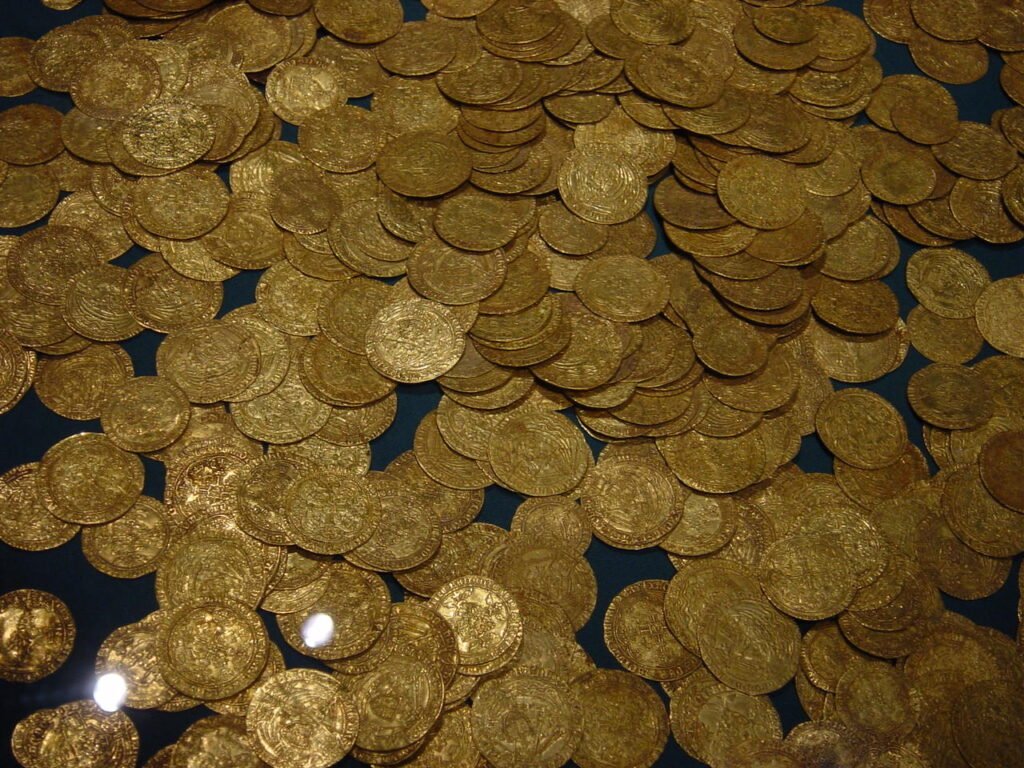
Featured image: “Hoard of ancient gold coins” by Swiss Banker, released into the public domain by its creator, via Wikimedia Commons.